
Near you, no matter where you are.
Appointed Representative of The Right Mortgage Network (FCA No. 1004260). Company No. 15189091. Registered in England and Wales.

Follow the UK first-time buyer process from budgeting and an Agreement in Principle to the mortgage application, exchange, completion and getting the keys.

Aug 11, 2025
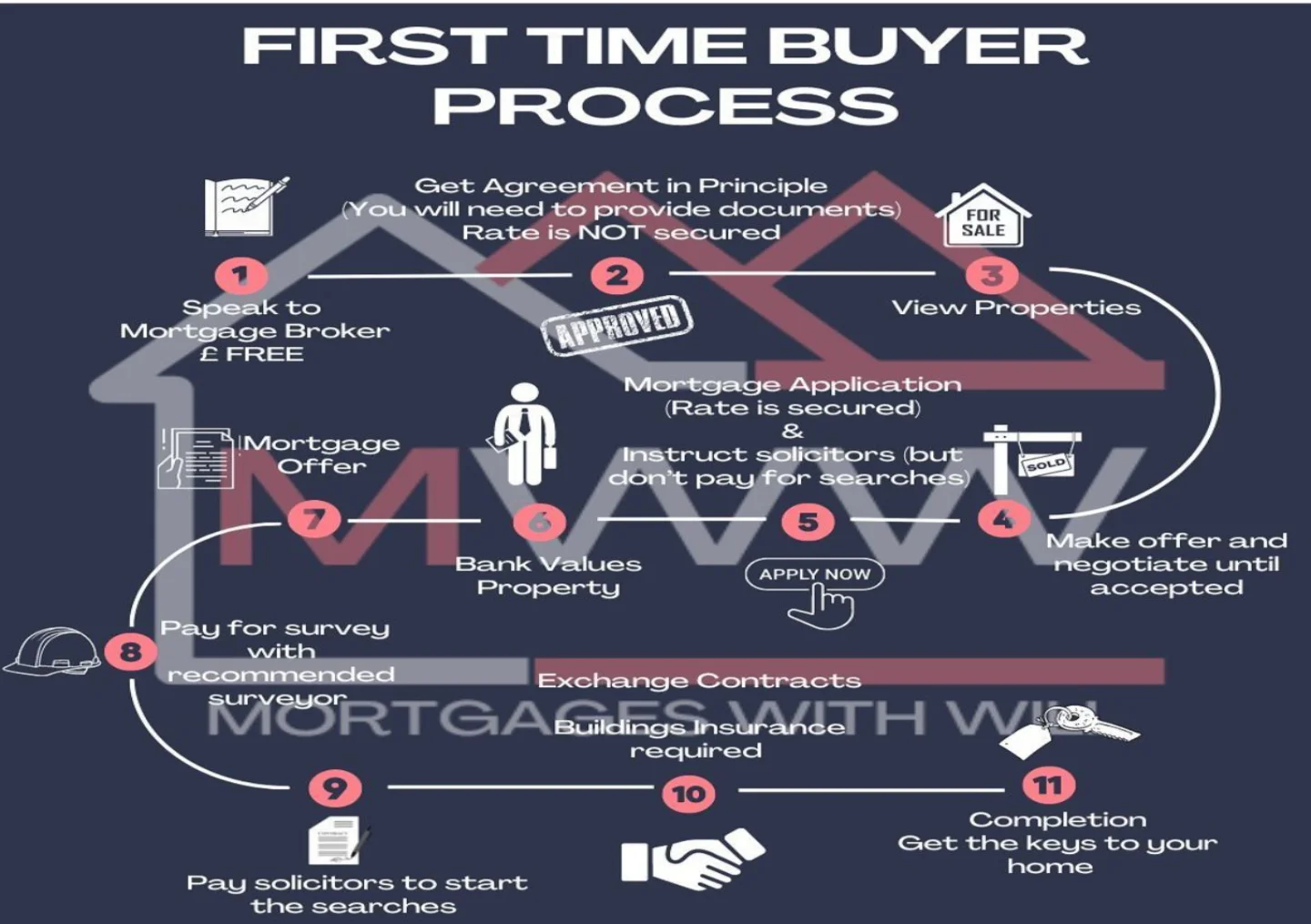
Buying your first home is easier to manage when you know which step comes next. The first-time buyer process usually starts with checking your budget and deposit, then getting an Agreement in Principle, finding a property, making an offer, submitting the full mortgage application, completing the legal work, exchanging contracts and finally collecting the keys.
The mortgage process and the home-buying process overlap, but they are not the same. Your mortgage adviser or lender deals with the borrowing. Your solicitor or conveyancer handles the legal transfer. The estate agent represents the seller, and a surveyor can inspect the property's condition.
Start by working out a realistic total budget, not just the maximum a lender might offer. Prepare your documents and get an Agreement in Principle before making serious offers. Once an offer is accepted, instruct a solicitor and submit the full mortgage application. The lender then checks you, the deposit and the property while your solicitor completes searches and enquiries. You become legally committed at exchange of contracts in England, Wales and Northern Ireland, or when missives are concluded in Scotland. Completion is the day the money is transferred and you receive the keys.
The broad mortgage stages are similar throughout the UK, but the legal buying process is different in Scotland. In Scotland, buyers normally involve a solicitor before making a formal offer, sellers provide a Home Report, and the contract becomes binding when missives are concluded. In England, Wales and Northern Ireland, the buyer usually makes an offer through the estate agent and becomes legally committed at exchange of contracts.
Your solicitor should explain the process and property tax rules that apply where you are buying.
Your budget is not simply your salary multiplied by a number. A lender will consider your income, debts, regular commitments, dependants, credit history, mortgage term and the way your income is earned.
You also need money for more than the deposit. Depending on the purchase, your costs may include:
Do not use every pound you have as the deposit without checking what must be paid before completion. Read our mortgage deposit guide and use the MBNM mortgage calculator for an initial estimate.
A calculator is useful for planning, but it cannot apply every lender's affordability rules. The amount you could borrow and the monthly payment you are comfortable with are also two different questions.
You can speak directly to a bank, compare lenders yourself or use a mortgage adviser. A bank can only discuss its own products. A broker can review a wider range, although the exact lender access and service vary by firm.
Early advice can be especially useful if you:
Before choosing an adviser, ask how they are regulated, which lenders they can consider, what the service includes and how fees work. Our guide to choosing a mortgage broker includes a full checklist.
Having clear, current documents ready can prevent avoidable delays. Requirements vary, but you may be asked for:
Check that names and addresses are consistent across your ID, bank accounts and credit record. Explain any large transfers rather than hoping they will not be noticed.
An Agreement in Principle, also called an AIP, Decision in Principle or Mortgage in Principle, is an initial indication of how much a lender may be prepared to lend.
It is useful because it can:
An AIP is not a mortgage offer. The lender has not yet fully assessed your documents or the property. It may use a soft or hard credit search, depending on the lender, so check before proceeding.
Read our guide to getting a mortgage in principle.
If you are unsure how a lender will treat your income, deposit or credit history, speak to MBNM before relying on an online result. We can review the figures and explain what may be realistic.
Use your working budget rather than treating the highest AIP figure as a spending target. Think about the property's condition and the ongoing costs as well as the asking price.
When viewing, ask about:
A flat, new build, listed building or non-standard construction property may have additional lender rules. Our guide to buying a flat explains common lease and service-charge issues.
In England, Wales and Northern Ireland, offers are normally made through the estate agent. State the amount, your first-time buyer position, your AIP status, your deposit and any conditions that matter to you.
An accepted offer is normally subject to contract. It does not mean the property is legally yours, and either side can usually withdraw before exchange. In Scotland, ask your solicitor to explain notes of interest, formal offers and closing dates before you act.
Do not be pressured into using an estate agent's mortgage adviser, solicitor or insurance provider. You can compare providers and choose your own.
Your solicitor or licensed conveyancer checks the legal title, orders searches, raises enquiries, deals with your deposit and coordinates the transfer of funds.
Before instructing them, check:
Tell them immediately if you are using a Lifetime ISA, gifted deposit, Shared Ownership scheme or funds coming from overseas. Each can require extra documents and time.
Once your offer is accepted and the property details are available, you can submit the full application. This is much more detailed than an AIP.
The lender will assess:
The underwriter may ask for more information even if you supplied documents earlier. This does not automatically mean the application is failing. A new question may arise from a bank statement, payslip, valuation or lender policy.
Common causes include missing or inconsistent documents, employer references, unusual income, gifted or overseas deposits, a busy surveyor, property concerns and further underwriting questions. The legal work can also continue after the mortgage offer has been issued.
MoneyHelper says a mortgage decision commonly takes around two to six weeks, but no single timescale applies to every case. A complex application or property can take longer.
Ask for advice before making a major financial or employment change. Taking new credit, increasing card balances, changing jobs, reducing hours or moving money without a clear record could affect affordability or trigger new questions.
Always tell the lender or adviser if something material changes. Hiding it can create a more serious problem later.
MBNM helps with straightforward PAYE applications as well as cases involving self-employed income, complex income and zero-hour contracts.
The lender's valuation is for the lender. It checks whether the property is suitable security for the mortgage and supports the value used in the application. It is not a detailed report on the condition of your future home.
Consider arranging your own survey at a level suitable for the property's age, condition and construction. A survey can identify repairs or further investigations you may want before becoming legally committed.
This is often called a down valuation. The lender may base its maximum loan on the lower figure. You may then need to:
Do not assume another lender will reach a different value. Review the reason and the financial risk before choosing the next step.
Your solicitor checks that the seller can transfer good title and investigates matters that could affect ownership or value. Work may include local authority, drainage, water and environmental searches, reviewing the contract and title, checking planning documents and raising questions with the seller's solicitor.
Leasehold, Shared Ownership and new-build purchases often involve extra documents. A leasehold review may cover the remaining lease term, ground rent, service charges, major works and management information. A new-build purchase can involve a reservation deadline and a long-stop completion date.
The mortgage and legal work usually run at the same time. A mortgage offer does not mean the legal checks are finished, and completed searches do not mean the lender must approve the mortgage.
If you are considering Shared Ownership, read our Shared Ownership mortgage guide.

If the lender is satisfied with you and the property, it can issue a formal mortgage offer. Check the offer with your adviser or lender and make sure you understand:
A mortgage offer is important, but you should still wait for your solicitor to confirm that the legal work is satisfactory before committing to exchange.
Before exchange in England, Wales and Northern Ireland, your solicitor should confirm that the contract, searches, enquiries, mortgage offer, deposit and proposed completion date are ready.
Once contracts are exchanged, you are normally legally committed to buy. Your buildings insurance may need to begin from exchange, so follow your solicitor's and lender's instructions.
The deposit paid at exchange is a legal contract deposit. It is often 10%, but a different amount can sometimes be agreed. This is not always identical to the mortgage deposit you used in your affordability calculations.
In Scotland, legal commitment happens through conclusion of missives rather than an exchange of contracts. Follow your Scottish solicitor's advice.
Before completion, your solicitor requests the mortgage funds and asks you for any remaining money. They complete final checks, transfer the purchase money and confirm when the transaction has completed.
The estate agent normally releases the keys only after the seller's solicitor confirms receipt of the funds. Your solicitor then deals with the tax return and registration requirements that follow completion.
There is no guaranteed timeline. The mortgage decision may take a few weeks, while the complete purchase commonly takes several months. The property chain, survey, lender, solicitor, searches, leasehold information and any problems found can all change the timescale.
A first-time buyer has no property to sell, which can make their position attractive to a seller, but it does not remove the legal, valuation or underwriting work.
There is no single type of first-time buyer. We help applicants including:
Having a less standard income or deposit does not automatically prevent a mortgage. It does mean lender criteria and evidence matter more.
Not necessarily. Lenders use their own assessments and consider the complete application. Recent or serious credit issues can restrict the options, but one score shown by a credit app does not decide every lender's answer.
Not always. Many standard options start at 5%, and limited lower or no-deposit products may exist. Availability, rates and criteria change, and some properties or circumstances require more.
False. It is an early indication, not a full mortgage offer.
False. The seller chooses whether to accept your offer. The lender decides whether to lend, and your solicitor handles the legal work.
False. Product fees, incentives, the mortgage balance, the initial period and early repayment charges can change the total cost.

Start by checking your deposit, credit record, income, commitments, buying costs and a comfortable monthly payment. This gives you a realistic budget before you view properties.
It is sensible to get one before making serious offers. It can show your likely budget and help identify issues early, but it does not guarantee a mortgage.
Usually no. A full application needs the property details because the lender must assess the property as security. You can prepare and obtain an AIP before finding one.
In England, Wales and Northern Ireland, many buyers choose a solicitor when they start searching and formally instruct them after an offer is accepted. In Scotland, you normally need a solicitor before making a formal offer.
It may need to clarify income, spending, a large transfer or the source of the deposit. Requirements can change during underwriting. Provide complete evidence and an accurate explanation.
A job change can affect the assessment, particularly if income, probation or contract terms change. Speak to your adviser or lender before making the change where possible, and disclose any material change promptly.
In England, Wales and Northern Ireland, this is normally when contracts are exchanged. In Scotland, it is when missives are concluded. Your solicitor will confirm the exact point.
No. You can apply directly. A broker may help you understand affordability, compare lender criteria, prepare the application and manage questions through to the mortgage offer.
If you are planning to buy your first home, MBNM can review your income, deposit, commitments and property plans, then explain which routes may be realistic.
Our first chat is free. We use it to understand your requirements and whether we can help. If we can help, we will then explain and discuss our fees with you.
There are no hidden fees, and we will not move ahead with anything until the fees have been agreed.
Speak to an MBNM mortgage adviser, call 0203 4884 491 or email enquiries@mbnm.co.uk.
You can also learn more about our first-time buyer mortgage service.
Your home or property may be repossessed if you do not keep up repayments on your mortgage or any other debts secured on it.
Mortgage Brokers Near Me Ltd is an Appointed Representative of The Right Mortgage Ltd, which is authorised and regulated by the Financial Conduct Authority. This article provides general information and does not constitute personalised mortgage advice. Property law and tax rules vary across the UK, so obtain advice for the country in which you are buying.

A high-value mortgage is a larger residential or buy-to-let loan, but there is no fixed UK threshold. Learn what lenders assess, how deposit and income affect borrowing, and when different lender routes may suit your case.
Read Article
Is Using a Mortgage Broker Worth It? A Complete Guide for Homebuyers in Essex
Read Article
Being on a zero-hour contract doesn’t automatically rule you out of getting a mortgage. While lenders see variable income as higher risk, many will still lend if you can show consistency, a solid work history, and reliable earnings. This guide explains how zero-hour contract mortgages work, how income is assessed, what deposit you might need, and how Mortgage Brokers Near Me help applicants avoid rejections and secure the right lender first time.
Read ArticleIf you’re buying, moving, or remortgaging, speak with a MBNM adviser and get clear guidance on what’s realistically available to you, before you commit to anything.
Near you, no matter where you are.
Appointed Representative of The Right Mortgage Network (FCA No. 1004260). Company No. 15189091. Registered in England and Wales.


